Updated
Achi
Achi is a mill game from West Africa, reportedly (in the 1920s) played in Ghana. It was also played by Yoruba people in Nigeria, where it was known as Akidada.H. J. R. Murray, A History of Board-Games Other Than Chess (1951), 43.
The game is very similar to Five Men’s Morris, but an additional form of mill is permitted, compared to the standard game. The game as reported below was recorded by Kenneth Murray, son of H. J. R. Murray and Nigeria’s first surveyor of antiquities.
It is possible that the name should really be transcribed adji, the name of a plant (Caesalpinia bonduc) that has large grey seeds suitable for use as gaming pieces.Tinde R. van Andel et al., ‘Local plant names reveal that enslaved Africans recognized substantial parts of the New World flora’ (2014). The same name is also used for a mancala game, so the name could be generic for all games played with these seeds.See also Herskovits (1929).
Play
© George Pollard🅭🅯🄏🄎
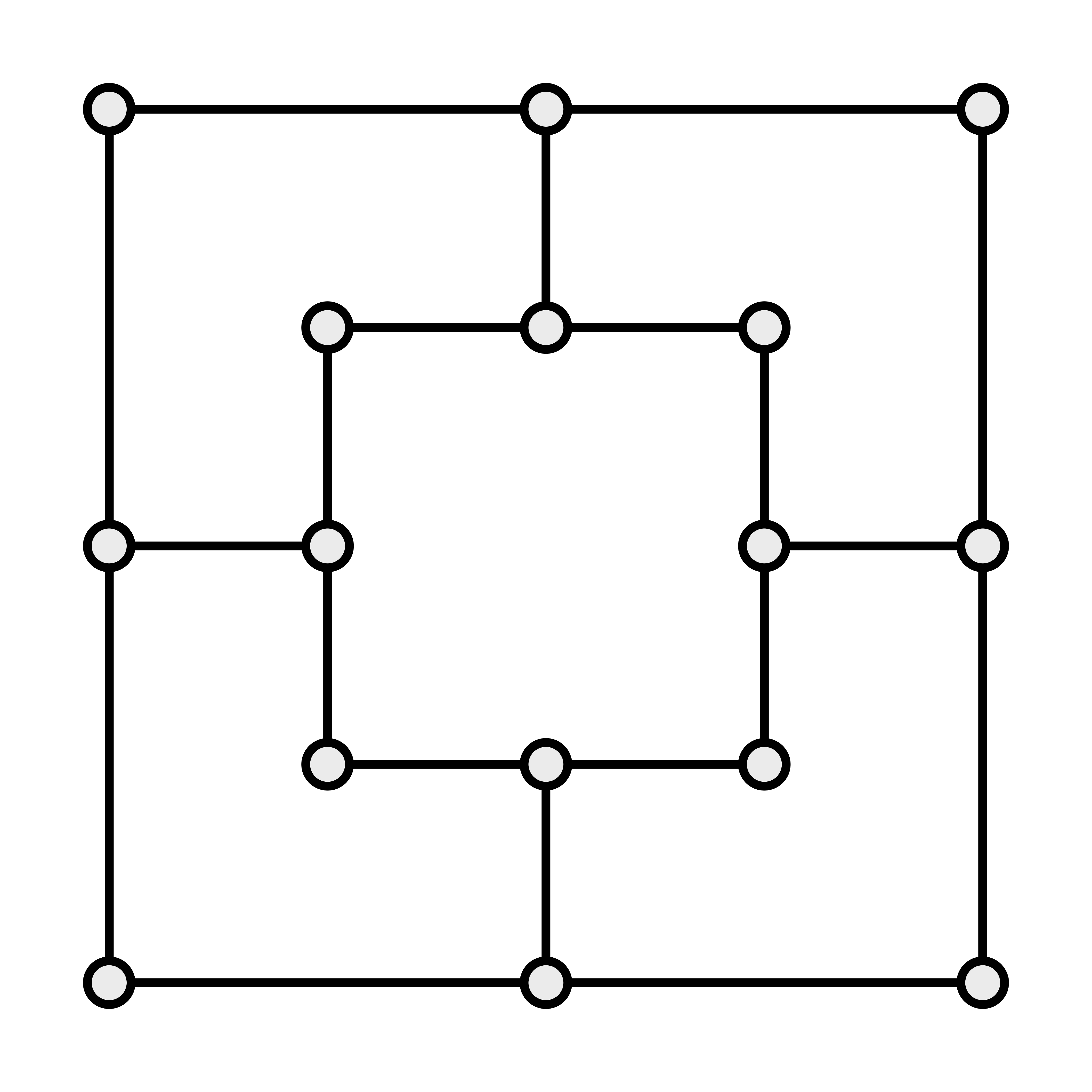
Achi is played on the medium-sized mill board.
Each player has six pieces. To begin the game, players take turns placing a single piece on any of the free points. If at any stage a player completes a mill, they can remove and capture any one of their opponent’s pieces.
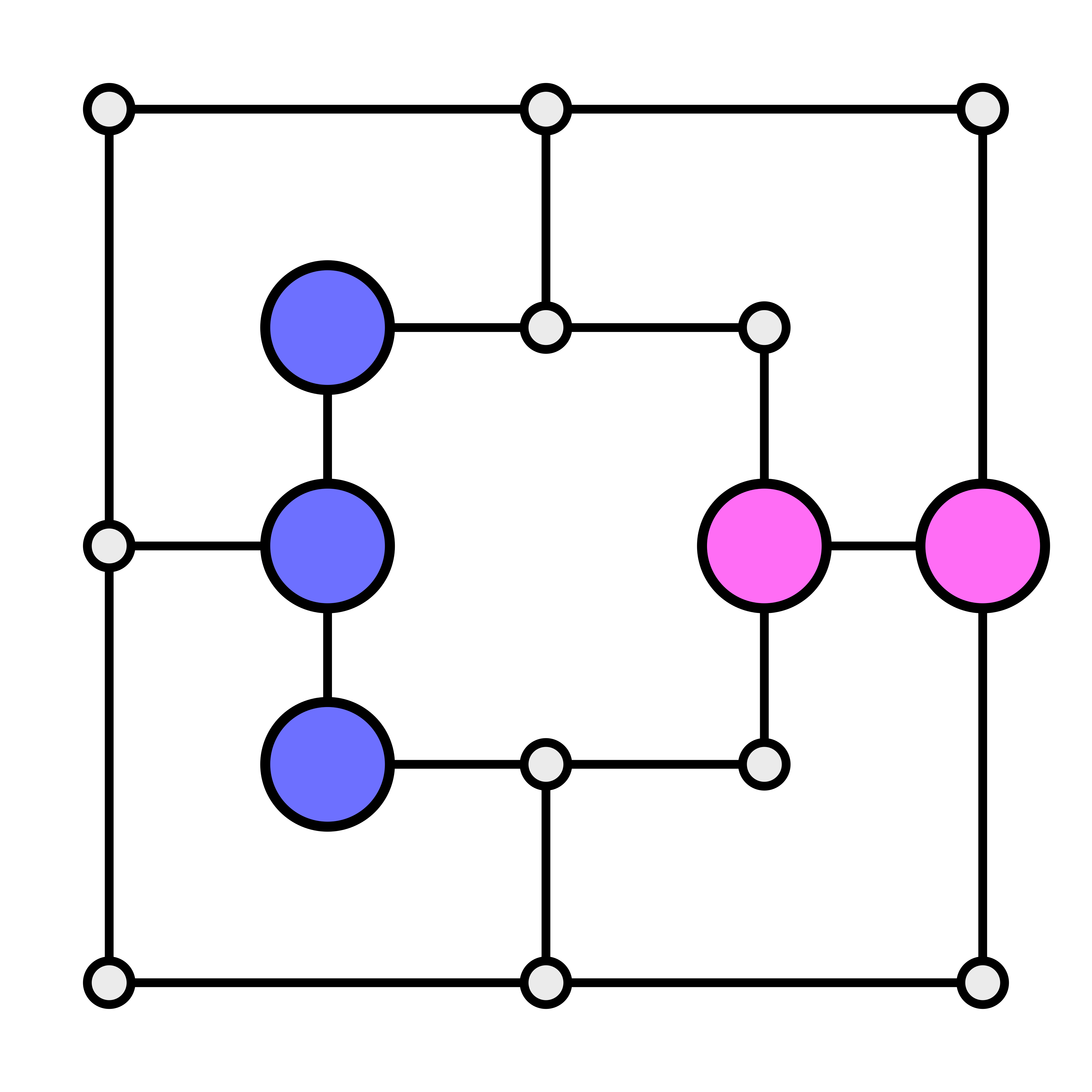
A valid mill, like in other mill games, consists of three pieces in a straight line. However, in Achi, a mill may also be formed by two pieces on the central lines on either side.
© George Pollard🅭🅯🄏🄎
Two examples of valid mills; the two-piece mill is unique to Achi.
Once a player has placed all their pieces, they then move one piece at a time from a point to any free point, along a line, attempting to form a mill. A player that is reduced to two pieces loses.
See also
Achi is sometimes misreported as a Three Men’s Morris game.
References
Herskovits, Melville J. (). ‘Adjiboto, an African Game of the Bush-Negroes of Dutch Guiana’. Man vol. 29, : pages 122–127.
Murray, H. J. R. (). A History of Board-Games Other Than Chess. Oxford University Press: Oxford, England, UK. ISBN: 0-19-827401-7.
van Andel, Tinde R., Charlotte I. E. A. van ‘t Klooster, Diana Quiroz, Alexandra M. Towns, Sofie Ruysschaert, and Margot van den Berg (). ‘Local plant names reveal that enslaved Africans recognized substantial parts of the New World flora’. Proceedings of the National Academy of Sciences vol. 111 (50), . doi:10.1073/pnas.1418836111.