八道行成 · Yasasukari
Last updated: .
Yasasukari (八道行成, also pronounced yasugari or yasukari) is an old board game, played in Japan, of the Fox and Geese family.A (p. 77)
The game is named in the book Wamyō Ruijushō (倭名類聚抄, ‘Japanese names, classified and annotated’), published in 938, so it was played in Japan since at least the Heian period. The name of the game also appears in the fifth-century Nirvana Sutra (Mahāparinirvāṇa sūtra, chapter 19), where it is described as a game to avoid,B (p. 205)For other games that the Buddha says to avoid, see Brewster (1958). One potential reason to avoid it is that the name overlaps with the Buddhist technical term 八道行 ‘following the eightfold path’. The 八道 ‘eightfold path’ is more commonly referred to as the 八正道 ‘noble eightfold path’. but it is possible that this might not refer to the same game.
The characters can also be read hachidōgyōjō, and often appears this way in translations of the sutra; but the first name given in this article is how the game is referred to in Japan.
Play
The description below is mostly based upon [D].
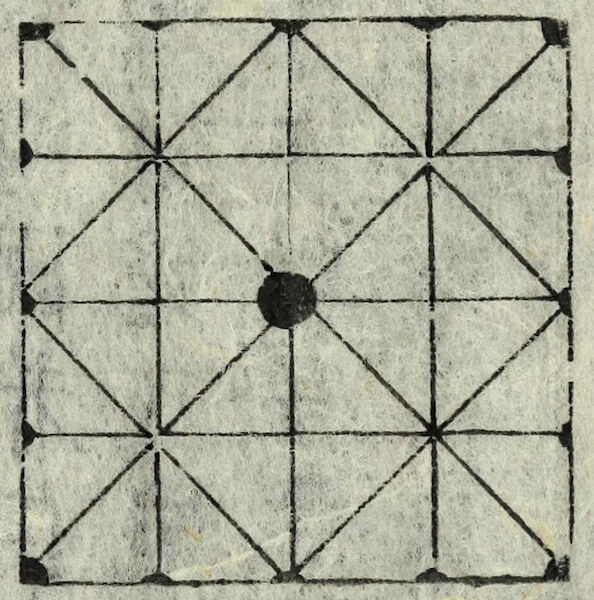
Diagram of the initial setup, from the Wakan SansaiZue (和漢三才図会, ‘Illustrated Sino-Japanese Encyclopedia’), first published in 1712.
One player has the single piece which starts in the centre, the other player has the 16 pieces that start on the intersections around the border.
The player with the single piece starts the game.
On each player’s turn they may move one of their pieces to any empty adjacent intersection. If the single piece moves to an intersection directly between two other pieces, it captures both of them.
The player with multiple pieces wins by surrounding the single piece so that it cannot move. The single piece player wins by reducing the number of other pieces so that they are no longer able to surround it.
See also
The game Sixteen Soldiers is probably a later version of this game.
References
Culin, Stewart (). Korean Games with notes on the corresponding games of China and Japan. University of Pennsylvania: Philadelphia, PA, USA. ark:/13960/t1pg2586d.
Lusthaus, Dan (). ‘What is ‘New’ in Xuanzang’s New Translation Style?’. Pages 159–219 in From Chang’an to Nālandā: The Life and Legacy of the Chinese Buddhist Monk Xuanzang (602?–664). World Scholastic. ISBN: 978-981-14-6185-9. World Scholastic.
Brewster, Paul G. (). ‘The Earliest Known List of Games: Some Comments’. Acta Orientalia vol. 23: pages 33–42. doi:10.5617/ao.5305.
高橋, 浩徳 [Takahashi Hironori] (). ‘八道行成’ [text in Japanese] [archived]. Boardwalk Community.